Executive summary
What existed
When I joined Paperturn as the company’s first marketing leader, the marketing function ran tactics across paid and organic without a positioning-to-content system underneath them. Meanwhile, AI Overviews were disrupting both organic and paid search.
What I built
235 pages in one quarter
3 automations for end-to-end messaging
Paperturn’s first integrated positioning system: a positioning research operating system with three automation tools that sat on top of it and 235 pages shipped.
What changed
26.3% → 63.3% paid LP engagement · same campaigns, new templates
20 → 12 same-page organic rank · 375 pages, impression-weighted
+103% / +134% US / UK trial-to-paid conversion rate uplift
The operating system
I built Paperturn’s AI-powered positioning research operating system based on Fletch’s positioning and go-to-market frameworks. The constant across all research was the role function (the marketer); the variable was the page topic. The research output showed the relationship a marketer has with our product offering at the intersection of their use cases, industries, and our publication types. This modular workflow depended on the cross-functional Ideal Customer Profile (ICP) work I did separately (see the strategic narrative case study).
The intent was specific: opening messaging should be as close to instantly understandable as possible, and I tailored page structure to keep readers engaged long enough to convert.
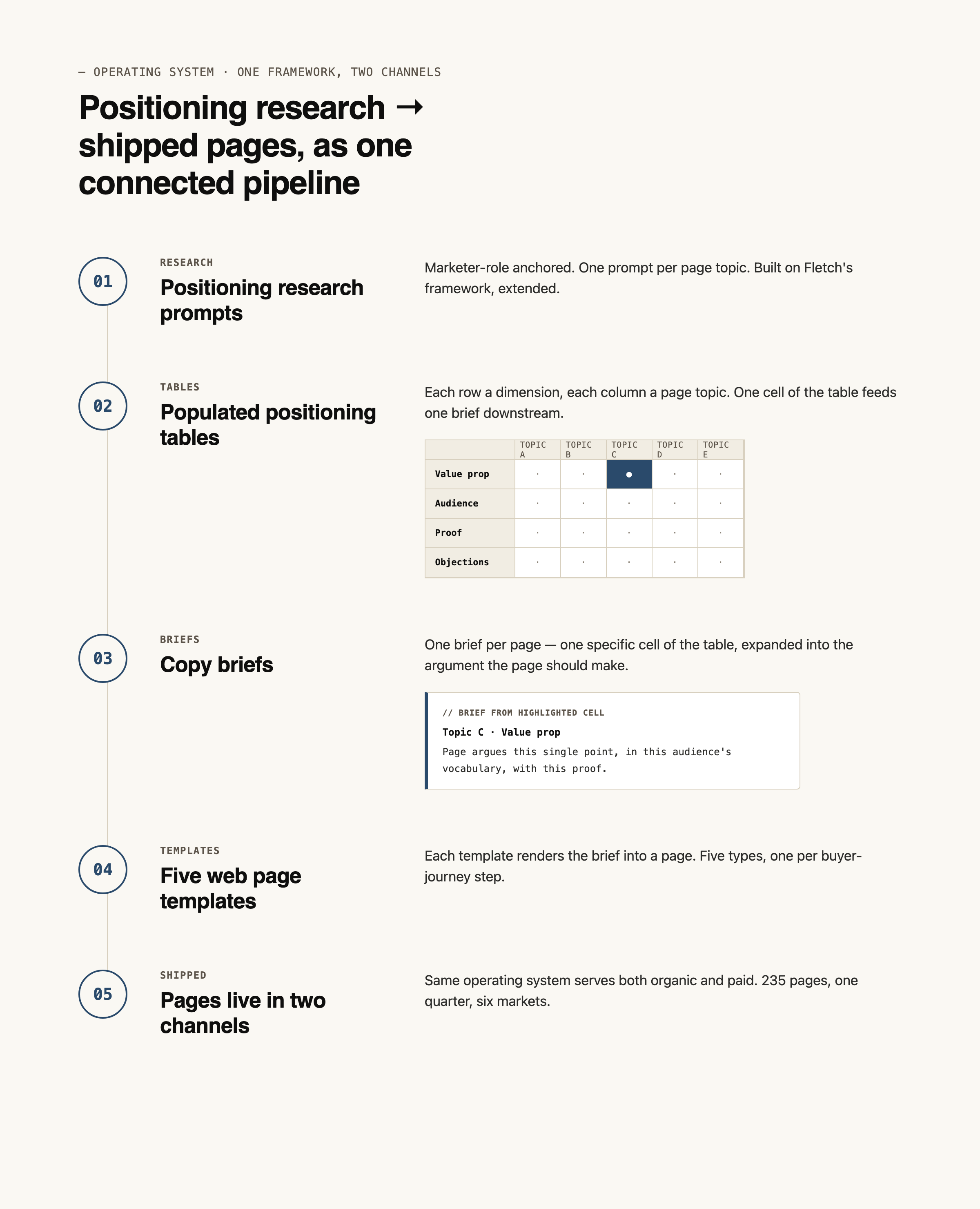
Five page types, five page topics
| Template | Starts from | Query intent / focus |
|---|---|---|
| Use-case page | A use case | Action verb + publication type — “create a brochure,” “make a magazine” |
| Industry page | An industry | Functions and terminology a marketer in that vertical actually uses |
| Feature page | A feature | Jobs-to-be-done that need it; capability unlocks, not feature lists |
| Role page | A role | Day-to-day responsibilities and pain points specific to the role |
| Ad landing page | A paid campaign | Demand brought to the site by paid; matches the ad’s promise |
The same research methodology ran across every page type. The constant was the marketer persona; the variable was the page topic. That intersection determined what the populated table contained, which determined what the page argued.
Without the operating system, 235 pages is 235 separate judgement calls. With it, 235 pages is positioning discipline applied through 5 templates.
The automation
Three tools sit on top of the operating system. All three compress weeks of human time into hours.
| Tool | Stage | What it does | Deployment |
|---|---|---|---|
| Positioning | Research | Industry-positioning workshop: 4–8h+ → ~30min per industry · 85% first-output buy-in | Worked best on real ICP brief; degraded to generic on thin inputs |
| Copywriting | Brief → page copy | Agent workflow: brief + populated tables → copy aligned to template intent (transactional, qualifying, capability-unlock). Optional second agent optimizes for GAds or SEO keyword targeting | Used across the 235-page rollout |
| Translation | Locale fan-out | Per-batch localization: ~6 weeks → ~3h per batch (46 EN × 5 locales) | 1 of 4 batches · capability proven; localization cadence didn’t expand fast enough for full leverage to compound |
The rollout
I ran a revenue analysis on revenue attributed to customer first-page-view and then analyzed on-page content to determine topic groups. The workflow was directed at pages correlated with paid-customer yield. That choice is why the publication-type query family (and its respective pages, a more commercial cut than other pages) is the family that moved the most.
235 pages shipped in one quarter: 46 English source pages translated into 5 locales, plus the ad landing pages and variations built on the same templates. I operationalized the system: AI drafted, interns ran content management system (CMS) execution, I reviewed all output. Once everything was in place, English pages cost about 2 hours each from copy generation through CMS input.
The outcome
Engagement on core paid landing pages, 26.3% → 63.3% (+37 pp). Same paid spend, same campaigns; the legacy /a.html paid LPs were replaced with /lp/* templates from the operating system’s 5th page type. Engagement rate on the post-migration set ran 63.3% across the 6 months after cutover, against a 26.3% baseline on the legacy pages. The cleanest before/after engagement signal in the data.
Same-page rank, 20 → 12 across 375 pages. Same URLs at the start and end of the window, weighted by January 2025 impressions so the page set and the weights stay constant. The exact pages that existed in January 2025 ranked 8 positions better in March 2026. A separate query-side cut points at the same work — the publication-type query family (catalog, brochure, magazine, ebook, menu, portfolio, invitation, manual, lookbook) moved from average position 20 to 12.
Lower position = better. Position 1 is the top of search results.
Paid trial-to-paid conversion, more than doubled in two markets. US moved from 7.3% (Mar–Aug 2024 weighted) to 14.8% (Oct 2025 – Mar 2026 weighted, +103%, 2.0×); UK from 7.3% to 17.1% (+134%, 2.35×). The rate is blended across all paid campaigns (Search, PMax, Competitor, Branded, DSA) using UpRaw conversion-action labeling on Trial and Purchase.
Directional, not isolatable. Same-window factors include keyword-pruning, PMax cannibalization, and the operating system itself. Better pages convert better whether traffic is organic or paid; I don't claim the framework alone produced the doubling.
The AI Overviews context
Sitewide clicks fell 27% across the window. The same 375 URLs that ranked 8 positions better got 31% fewer impressions. Click-through rate held up reasonably (0.93% → 0.84%); the cannibalization happened at the impression level, not at the click level. That’s the AI Overview signature: Google’s AI panel answered the query before the organic result was shown. The 27% decline sits in the middle of the industry’s reported 20–40% range on informational SaaS content in the same window. Search analytics alone can’t isolate AI Overviews as the cause; the pattern is consistent with published research. The rollout was designed to win on rank and expand the keyword footprint. It did both. The click math was fighting an industry-wide headwind.
What persists
The operating system is still running. Sitewide organic position is holding around 10 as of April 2026 (per the intern I hired and trained, who is still at Paperturn). The 235 pages are still indexed.
The operating system was the leverage piece. It enabled the output. Without it, the rollout doesn’t ship in a quarter and the same pages don’t rank 8 positions better against industry-wide compression.